Imagine you’re in a lush forest. Every unique tree and every rustle in the leaves is a testament to speciering, nature’s way of creating new life. It’s an intricate process where one species branches off to form a brand new one, perfectly suited to a different environment.
Speciering isn’t just a complex science term; it’s the very engine of evolution. It shows us how life on Earth transforms and becomes incredibly diverse over time. By looking at real-world examples, we can truly appreciate how this process drives biodiversity and keeps our ecosystems healthy.
Let’s dive into the fascinating world of speciering with clear examples and easy-to-understand insights!
What is Speciering? A Simple Explanation
Speciering is simply the process by which a new species emerges from a single ancestral one. It’s a cornerstone of evolutionary biology, explaining how life’s tree branches out over long periods.
At its heart, speciering involves genetic changes and adaptations that help a population survive better in its specific environment. These differences can arise due to various reasons, such as being separated by geography, finding new ways to get food (ecological niches), or even just different mating preferences.
When groups of organisms get separated—whether by a mountain range, a river, or a preference for different food sources—they start to evolve on their own. Over many generations, the changes add up until they reach a point where the groups can no longer successfully interbreed.
Understanding speciering helps us appreciate the incredible variety of life on Earth. Each unique species is a chapter in the amazing, ongoing story of evolution, written by the pressures of the environment and the endless opportunities for survival.
How Does Speciering Happen? The Process
Speciering is a dynamic process that starts when populations of the same species begin to diverge (move apart) over time, ultimately leading to the creation of new species.
Often, geographic isolation is the first major step. When physical barriers like a new river, a growing mountain, or a patch of open ocean separate a group, they begin to evolve independently.
Genetic mutations and natural selection are the primary drivers. These changes cause one group to develop adaptations that make them a better fit for their specific, separate environment.
As these differences accumulate, reproductive isolation eventually happens. This means that even if the two groups come back into contact, they are no longer able to produce fertile offspring together.
This combination of mechanisms weaves the vibrant tapestry of life we see on Earth. Every step in this process shows just how resilient and diverse nature is.
Amazing Examples of Speciering in the Wild 🏞️
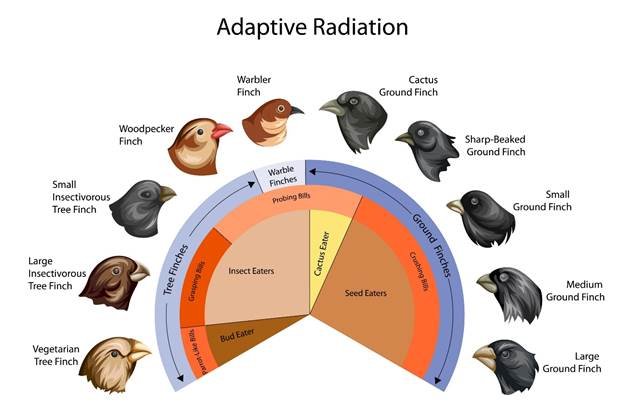
The Galápagos Islands offer some of the best evidence of speciering. Here, Darwin’s finches evolved distinctly different beak shapes based on the food sources available on their specific islands. Each species adapted its beak to efficiently eat seeds, nuts, or insects, perfectly showcasing natural selection in action.
Another spectacular case is the cichlid fish in Africa’s Great Lakes. Hundreds of species have rapidly evolved from a single ancestor, mainly because of varying water habitats and strong mating preferences (like bright colors). Their fast diversification shows how environmental differences can quickly drive speciering.
Even common species show change. The apple maggot fly in North America is an example of speciering driven by behavior. Originally, these flies laid eggs only on hawthorn fruit. When colonists introduced apples, some flies began laying eggs on them instead. Because flies that use apples emerge and mate at different times than those using hawthorn, they are evolving into two separate, reproductively isolated populations.
These examples offer great insight into nature’s immense power for change and adaptation through the process of speciering.
Why Speciering Matters: Biodiversity and Ecosystems
Speciering is absolutely critical for creating and maintaining biodiversity. When new species emerge, ecosystems become more complex and more resilient (better able to handle stress).
Every speciering event opens up new ecological niches. Species adapt to their environments in unique ways, leading to a diverse range of survival strategies. This high diversity strengthens the overall health and stability of an ecosystem.
Furthermore, speciering influences food webs. As new species evolve, they take on varied roles—some become new predators, others new prey, and some fill specific roles as decomposers or pollinators. This specialization fosters stability and balance in nature.
In short, understanding speciering helps us see the intricate connections between living things and their environments. It underscores just how vital conservation efforts are to protect the ongoing process of life’s diversification.
Challenges and Future of Speciering Study
Speciering, though fundamental, is not without its challenges. One major debate revolves around the definition of a species itself. For instance, the most common definition focuses on reproductive isolation, but what about cases where species can occasionally hybridize (interbreed)?
Hybrid species blur the lines between distinct groups. This makes our classification system, known as taxonomy, much more complicated.
Also, rapid environmental changes, like those driven by climate change and habitat destruction, may be accelerating changes in populations. This might lead to an increase in hybrid forms rather than clear-cut new species, challenging our traditional models.
Looking ahead, scientists are using cutting-edge methods to study speciering. Advances in genetic sequencing offer deep insights into the molecular changes that drive the process. Combining this genetic data with ecological field studies is giving researchers a complete picture of how environmental and genetic factors interact.
The future of this field promises exciting new revelations, especially as technology like machine learning helps scientists manage and analyze incredibly complex data sets, further illuminating the incredible ways life evolves and adapts.